
For years, the path to becoming a professional trader followed a rigid script: pay for an evaluation, hit a 10% profit target without breaking strict drawdown rules, and wait weeks—if not months—to see your first dollar.
However, a new model has emerged that is forcing traditional firms to rethink their entire business strategy: Instant Funding. This model bypasses the “audition” phase entirely, granting traders immediate access to capital. But as the saying goes, “there is no such thing as a free lunch.”
Below, we dive deep into whether this shortcut is a career-maker or a calculated trap.
What Exactly is Instant Funding?
In a traditional evaluation (like those offered by FTMO or Fintokei), you are essentially paying for a “test.” If you fail, the firm keeps your fee. If you pass, they give you a funded account.
Instant Funding flips the script. From the moment you pay your activation fee:
- You are trading a live-simulated account.
- Any profits you generate are eligible for a split (usually 50% to 80%).
- There are no “Phase 1” or “Phase 2” profit targets to reach before you can withdraw.
⚖️ The High Stakes of Speed: A Detailed Comparison
While the appeal of immediate payouts is undeniable, the structural differences between these accounts and traditional evaluations are massive.
1. The Cost of Entry
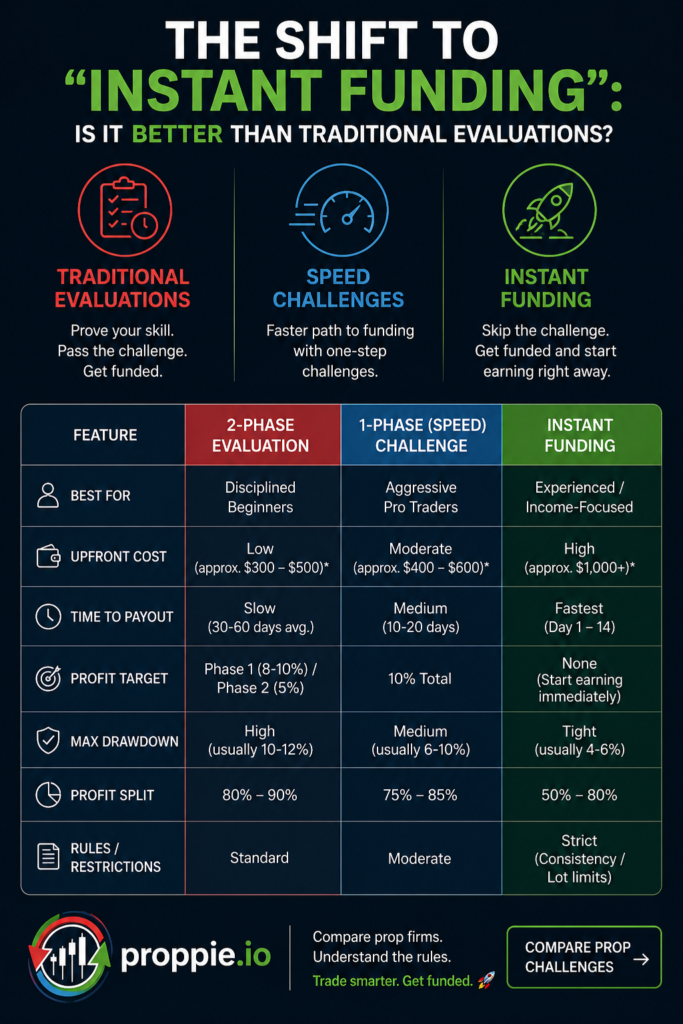
Instant Funding is significantly more expensive. For a $50,000 account, a traditional evaluation might cost you $300. An Instant Funding account of the same size could cost $1,000 or more. You are essentially paying a premium to skip the “proof of skill” phase.
2. Drawdown Constraints
Because the firm is taking on more risk by giving you capital immediately, the “leash” is much shorter.
- Traditional: Often allows a 10% maximum drawdown.
- Instant: Often capped at 5% or 6%.
This means you have much less “error room” before your account is terminated.
3. Scaling Potential
Traditional accounts usually allow you to scale up to $1M+ by proving consistency. Instant accounts often have lower ceilings or much more aggressive requirements to increase your starting capital.
Avoiding the “Liquidity Trap”
Not all Instant Funding firms are created equal. Since the firm isn’t “testing” you, some less-reputable companies design their rules specifically to make you fail. Look out for these predatory tactics:
- The “Daily Drawdown” Trap: Some firms calculate drawdown based on your equityhigh point during the day, not your balance. This means if you are up $1,000 and the trade retraces to $200, you’ve effectively “lost” $800 of your drawdown limit.
- Minimum Trading Days: Even if you make a profit on day one, many firms won’t let you withdraw until you’ve placed trades on at least 10 or 20 separate days.
- The Consistency Rule: This is the most controversial rule. It requires that no single trade accounts for more than, say, 30% of your total profit. It’s designed to stop “one-hit wonders,” but it can penalize legitimate traders who catch a massive trend.
Who is This For?
Instant Funding is for you if:
- You have a proven strategy and a track record of profitability.
- You have the liquid capital to pay the higher upfront fees.
- You are an “income-focused” trader who needs cash flow now rather than a large account later.
Stick to Evaluations if:
- You are still refining your discipline.
- You are trading on a budget.
- You want the highest possible leverage and drawdown limits.
Final Thought
The rise of Instant Funding represents the “democratization” of capital, but it requires a higher level of professional maturity. In 2026, the best traders aren’t the ones who get funded the fastest—they are the ones who stay funded the longest.
| Feature | 2-Phase Evaluation | 1-Phase (Speed) Challenge | Instant Funding |
|---|---|---|---|
| Best For | Disciplined Beginners | Aggressive Pro Traders | Experienced / Income-Focused |
| Upfront Cost | Low (approx. $300 – $500)* | Moderate (approx. $400 – $600)* | High (approx. $1,000+)* |
| Time to Payout | Slow (30-60 days avg.) | Medium (10-20 days) | Fastest (Day 1 – 14) |
| Profit Target | Phase 1 (8-10%) / Phase 2 (5%) | 10% Total | None (Start earning immediately) |
| Max Drawdown | High (usually 10-12%) | Medium (usually 6-10%) | Tight (usually 4-6%) |
| Profit Split | 80% – 90% | 75% – 85% | 50% – 80% |
| Rules / Restrictions | Standard | Moderate | Strict (Consistency/Lot limits) |